In brief
- The equipment travels, not the component — most industrial assets cannot be moved
- Nearly every method is portable — including phased array, TOFD and digital radiography
- Mobilisation depends on access, power and permits, not on distance
- Site safety certification determines whether a contractor can enter a plant at all
- Reports issued on site, not weeks later
A mobile NDT laboratory means bringing the instruments, the certified personnel and the approved procedures to the component — rather than sending the component to a laboratory.
For most industrial inspection this is not a convenience but the only option. A pressure vessel, a storage tank, a pipeline, a turbine casing or a welded structure cannot be crated up and shipped. Even where a component could physically travel, the cost of dismantling, transport, reinstallation and the resulting downtime usually exceeds the cost of the inspection several times over.
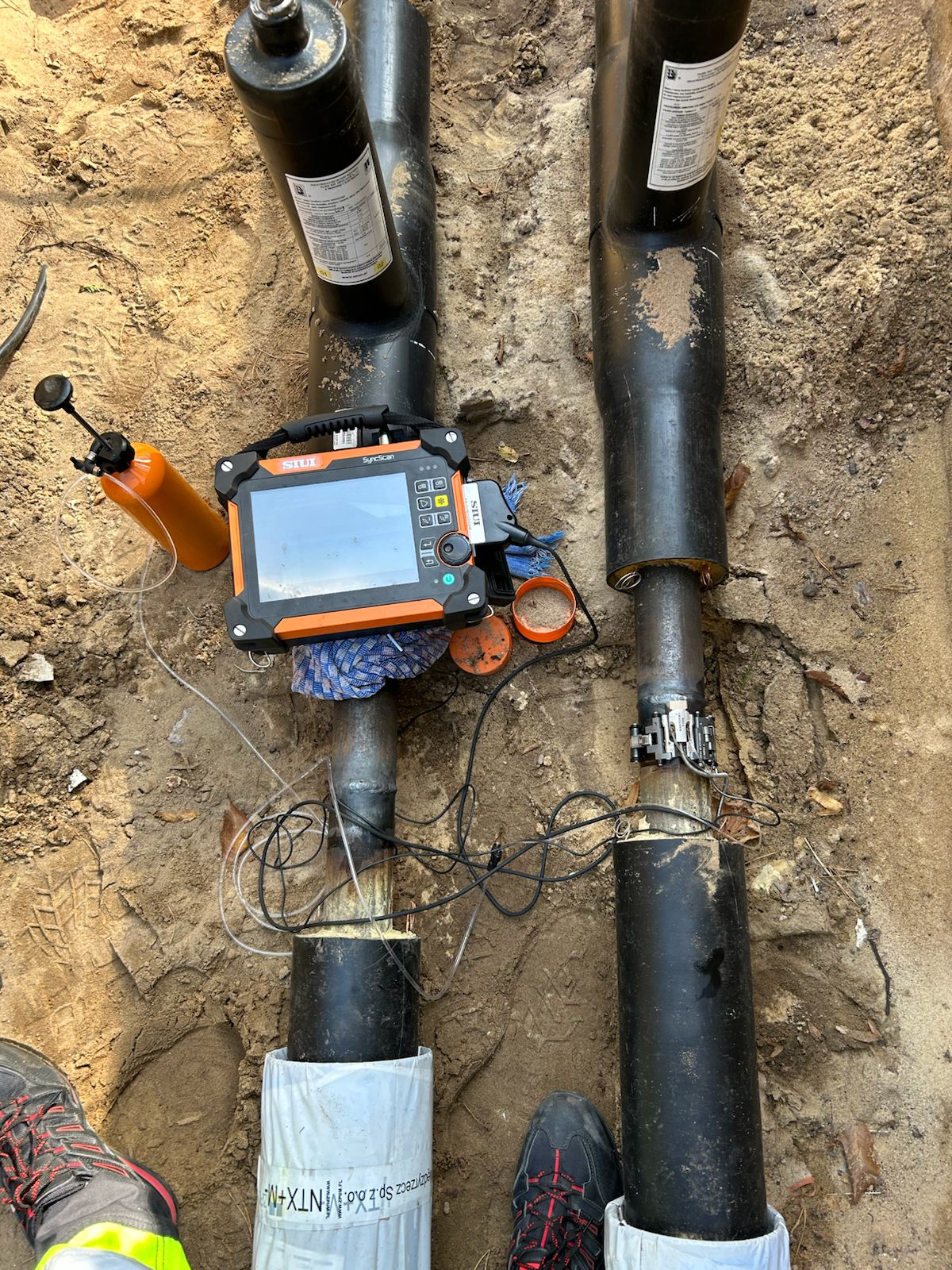
When on-site inspection is the only realistic option
Shutdowns and turnarounds. The window is fixed, expensive, and every hour counts. Inspection has to happen inside it, and results have to be available fast enough to make repair decisions before the window closes.
In-service assessment. Corrosion surveys, wall thickness monitoring, crack detection on operating plant. The equipment stays where it is.
Fabrication and prefabrication. Weld inspection during construction, at the fabricator’s yard or on the assembly site, where a defect found now is repaired in hours and a defect found later requires dismantling.
Acceptance and commissioning. Third-party verification before handover.
Incoming material verification. PMI and hardness testing at the point of receipt, before material disappears into a fabrication yard.
Failure investigation. Where something has broken and the surrounding structure must be assessed before restart.
What travels — and what does not
Almost every NDT method has a genuinely portable implementation. The interesting question is what changes when it leaves the laboratory.
The two methods that impose real constraints on site are the ones involving radiation: radiography requires a controlled area, cordoning and dose monitoring, and XRF for PMI is regulated equipment operated under procedure.
Everything else can proceed alongside ongoing work — which is a substantial part of why PAUT is increasingly specified in place of radiography. No exclusion zone means no interruption to production.
How mobilisation actually works
The variable that governs mobilisation is rarely distance. It is access, permits and site conditions.
Before mobilising, the following should be established:
- Scope — which components, which welds, which methods, to which standard and acceptance criteria
- Access — scaffolding, rope access, confined space entry, work at height, whether the area will be free of other trades
- Surface condition — who removes coating, scale and insulation, and when
- Utilities — power availability and type; compressed air where needed
- Permits — hot work, confined space, radiation work, site induction
- Isolation — whether the equipment will be depressurised, drained, cooled and isolated
- Timing — the window, and whether night or shift work is required
Most delays on site come from one of these being assumed rather than agreed. A checklist issued and returned before mobilisation removes nearly all of them.
What the client typically provides: safe access, a prepared surface where specified, isolation and permits, a point of contact with authority to make decisions, and drawings or an inspection test plan identifying what is to be examined.
What determines whether a contractor can enter at all
For a plant operator, admitting an external team is a safety decision before it is a technical one. Three things are checked:
Site safety certification. SCC (Safety Certificate Contractors) is the recognised scheme across the Netherlands, Belgium, Germany and Austria, and is frequently a precondition for entering a chemical, refining or energy site in those countries. Without it, a technically excellent contractor does not get through the gate.
Environmental management. ISO 14001 certification is increasingly required in tender qualification.
Radiation authorisation, where radiography or XRF is in scope — an authorisation from the national regulator and a qualified radiation protection officer.
Personnel qualification. ISO 9712 certification per method and level. Level 2 to evaluate results, Level 3 to write and approve procedures — the difference that matters when a project needs a procedure written for its own specification.
Reporting
The advantage of on-site work is lost if the report takes three weeks.
Preliminary results are available during the inspection. Ultrasonic and phased array results are read immediately; digital radiographs appear within minutes; leak test indications are visible as they occur. Repair decisions can be made while the scaffold is still up.
The formal report identifies the components examined, the procedure and standard applied, the acceptance criteria, the equipment and its calibration status, the personnel and their certification, and every indication with its location and evaluation. Digital scan data and radiographs are supplied in reviewable format, so a third party or the client’s own Level 3 can re-examine the result without a repeat inspection.
Frequently asked questions
Do you travel to sites outside Poland?
Yes — we operate across Europe. Gamma radiography is available for projects in Poland, where we hold the required authorisation for radioactive sources; outside Poland we operate X-ray equipment up to 250 kV, and use PAUT or TOFD where thickness exceeds its practical range.
How quickly can a team mobilise?
It depends on scope, permits and access rather than distance. Straightforward inspections mobilise within days; work requiring radiation notifications, specialised procedures or site inductions needs longer. The controlling factor is usually the client’s own permit process.
What do we need to prepare before you arrive?
Safe access, surface preparation where specified, isolation and permits, and an agreed scope with acceptance criteria. We issue a preparation checklist before mobilisation.
Can inspection be done while the plant is operating?
Some of it. Thickness measurement, tangential radiography and external corrosion surveys can often be performed on-stream. Anything requiring a controlled area affects surrounding work, and internal inspection requires isolation.
Can you write the inspection procedure?
Yes. We hold ISO 9712 Level 3 in all five principal methods — VT, PT, MT, RT and UT — so procedures for a specific project specification are written and approved in-house rather than subcontracted.
What certifications do you hold for site access?
SCC and ISO 14001, with a quality management system implemented to the requirements of ISO/IEC 17025.
Planning an outage, a fabrication programme or an acceptance inspection?
We bring certified personnel, approved procedures and portable instrumentation — conventional and phased array ultrasonics, TOFD, TFM, digital radiography, surface methods, PMI and hardness — to sites across Europe.
→ NDT services · Weld inspection · Request a quote